Computers
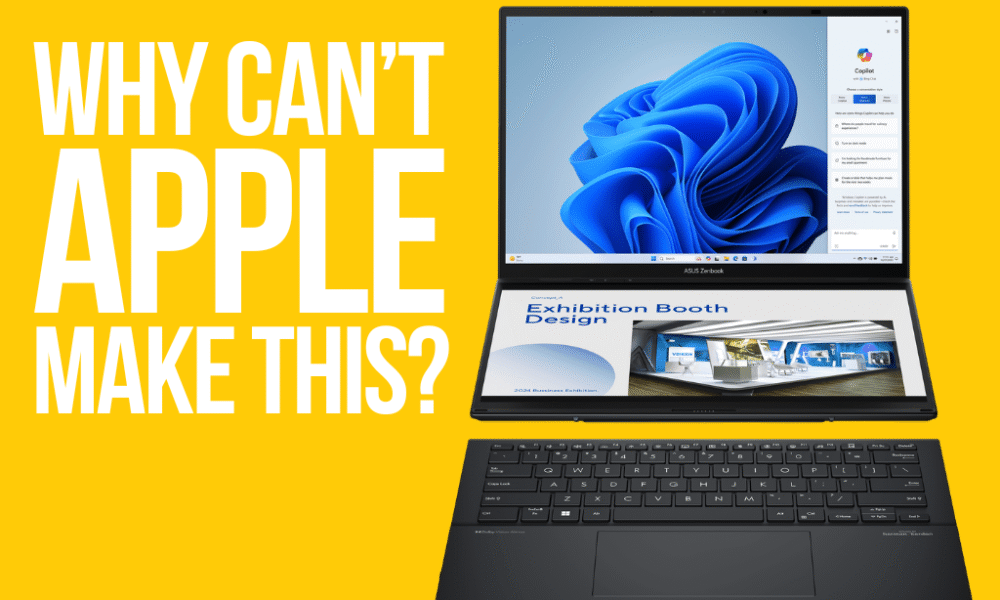
Why Can’t Apple Make This?
An Unrepentant Mac User Finds Innovation on the Other Side of the Aisle
I need to confess something that, just a few short years ago, would have felt like a sacrilege punishable by an immediate Genius Bar ban: I bought an Asus ZenBook Duo.
I am, and have always been, an Apple user. A true believer. My ecosystem is fully saturated—iPhone 17 Pro Max, Apple Watch Ultra 2, AirPods Max, and a 16-inch M3 Max MacBook Pro sitting right beside my desk, sleek and silver and, frankly, boring. My computing life has been defined by the walled garden, prioritizing stability, seamless integration, and the undeniably superior performance of the M-series chips. I bought into the idea that Apple’s design philosophy—the relentless pursuit of simplicity—was inherently the most advanced.
But the Mac has changed. Not in performance—the silicon is still mind-blowing—but in philosophy. It has become safe, predictable, and stubbornly resistant to the kind of radical experimentation that defined the company for decades.
This is where the ZenBook Duo came in. I ordered it out of pure, morbid curiosity, fully intending to write a takedown piece on the supposed gimmicks of PC hardware. What I received was a machine that fundamentally changed how I work. And the moment I deployed that secondary screen, tilting up seamlessly from the chassis, the question I’ve been wrestling with for weeks solidified into a frustrated scream: Why can’t Apple make this?
The form factor of the ZenBook Duo is, simply put, breathtakingly innovative.
The Revelation: Two Screens Are Better Than One
Let’s be clear: I am not a PC guy. I still cringe a little when I click the Start menu. But the hardware itself—the chassis, the hinge, the dual 14-inch OLED displays—is a masterclass in portable engineering. This is not a concept demo; this is a fully realized, mass-market device shipping today in 2025.
When you open the ZenBook Duo, the primary screen is immediately apparent, but the magic happens below. The keyboard is detachable, covering a second, full-sized display. When you undock the keyboard, that lower screen rises slightly, positioned at a comfortable angle thanks to a sophisticated hinge mechanism. You instantly have two full-sized screens, one above the other, in a single, perfectly balanced laptop chassis.
My entire Mac workflow relies on external monitors—a massive Studio Display flanked by a secondary vertical monitor—because macOS is a window-management nightmare, and complex tasks require massive screen real estate. The ZenBook Duo gives me 80% of that external monitor setup, fully integrated, with total portability.
Use Case Examples:
- Coding/Development: Main screen for IDE (VS Code), Secondary screen for documentation and testing terminal output.
- Video Editing (DaVinci Resolve/Adobe Premiere): Main screen for the timeline and preview, Secondary screen for media bins and scopes.
- Writing/Research: Main screen for the article I’m drafting, Secondary screen for half a dozen research tabs and note-taking apps.
It is a productivity cheat code. The argument against it—that the keyboard is pushed to the edge, or the second screen is too small—falls apart instantly when you see the tangible benefits. This isn’t a minor iteration; it’s a paradigm shift in laptop design, prioritizing function and workflow in a way the MacBook chassis has simply refused to do.
The Stagnation of the Silver Slab
Apple’s greatest internal innovation—the M-series chips—has ironically masked a deep, fundamental external stagnation. The current MacBook Pro design, while refined, is essentially an evolved version of the 2021 chassis, which itself was an attempt to fix the mistakes of the 2016 model. It’s a gorgeous, robust, CNC-milled aluminum slab. It is functionally perfect. It is aesthetically done.
But when did “done” become the death knell of a company built on disruption?
While Apple was busy making the M3 chip 20% faster than the M2, companies like Asus, Dell (with their Concept Luna experiments), and even Lenovo (with their flexible screens) were fundamentally rethinking the relationship between user and machine. They are innovating in form factor, input, and display technology.
For an Apple user, the ZenBook Duo highlights the most glaring, embarrassing deficiency in the modern Mac lineup, one that has become utterly indefensible in 2025: The complete lack of a touch screen.
The Indefensible Truth: No Touch Screen
Today, in 2025, you cannot purchase a MacBook with a touch-sensitive display.
The argument, famously attributed to Steve Jobs and his “gorilla arm” theory (the fatigue of constantly reaching up to touch a vertical screen), feels prehistoric now. It’s an argument rooted in a 2000s desktop PC paradigm, not a modern, mobile computing environment.
Look at the evidence:
- The iPad Pro is a Laptop: Apple has poured massive resources into making the iPad Pro a laptop replacement. They created the Magic Keyboard, a $300 accessory that makes the iPad look and function exactly like a laptop. When you use an iPad, you effortlessly alternate between the trackpad/keyboard and direct touch. It is a hybrid experience.
- The Touch Bar Proved They’re Open to Touch: The ill-fated Touch Bar, while a deeply flawed solution, demonstrated that Apple was willing to introduce a touch-sensitive OLED surface into the keyboard area. They just put it in the most useless possible location.
- The Competition Has Mastered It: Every serious competitor—the Microsoft Surface Laptop, Dell XPS line, HP Spectre—offers high-quality, reliable, beautiful touch screens. It is no longer a gimmick; it is an expected, baseline feature of a premium laptop.
Apple’s excuse has always been that touch input is for the iPad, and cursor input is for the Mac, and the two shall never meet. This is an artificial, self-imposed limitation designed to protect the highly lucrative iPad Pro line from cannibalization. They are intentionally holding back the Mac because they are afraid the perfect, innovative laptop would eat into the sales of another one of their products.
The fact is, a Mac with a touch screen wouldn’t make the iPad obsolete; it would make the Mac complete. Imagine tapping a small macOS button, intuitively scrolling a long webpage, or using the beautiful, responsive display for quick drag-and-drop operations without lifting your hand to the trackpad. The gorilla arm argument isn’t about user comfort; it’s about corporate ledger protection.
The Dual-Screen Denial: A Workaround, Not a Solution
When I praise the ZenBook Duo, Apple loyalists inevitably bring up Sidecar or Universal Control.
“You can just set your iPad next to your MacBook and use it as a second screen!”
Yes, you can. And it’s a brilliant piece of Apple software engineering. But it is, emphatically, a workaround.
The Sidecar setup is a multi-device mess:
- 💻 You have to carry two expensive devices (MacBook + iPad).
- 💻 You have two batteries to charge.
- 💻 You need desk space to lay both devices flat.
- 💻 You have two separate ecosystems trying to communicate.
The ZenBook Duo solves this in one, elegant, fully integrated chassis. It is a single purchase, a single charger, and a single hinged piece of aluminum. It delivers a superior, instant, and uncluttered dual-screen experience.
Apple’s philosophy—to use two different, high-margin products to achieve a simple workflow—is cynical. Competitors look at a problem (“Users need more screen space on the go”) and build a single product to solve it. Apple looks at the same problem and says, “We already have two products that can solve this if you buy both.”
The Fear of Cannibalization vs. The Call for Leadership
So, why are they so far behind? It comes down to one of two possibilities: Arrogance or Fear.
The Arrogance Thesis: Apple truly believes their approach is the best, and any non-standard form factor is a gimmick that would sully the purity of the Mac experience. They look at machines like the Duo or the foldable PCs and dismiss them as inelegant or unnecessary. This is the company that once shipped a single USB-C port and declared, “You don’t need ports,” only to walk it back years later. They are historically prone to telling the market what it wants, rather than listening.
The Fear Thesis (The more likely): Apple is terrified of the perfect laptop. A dual-screen, touch-enabled MacBook Pro running M-series chips would be a category killer. It would instantly render the existing 16-inch MacBook Pro chassis look archaic and, more critically, it would decimate the sales of the high-end iPad Pro. The internal conflict between the Mac team and the iPad team seems to have created a stalemate, where Mac innovation is sacrificed to preserve the iPad’s market share.
The Challenge to Cupertino
Apple’s M-series chips have the thermal efficiency and battery life to create a dual-screen device superior to anything else on the market. An M4 chip in a ZenBook-like chassis could run for 15 hours straight, barely breaking a sweat, whereas the current PC versions require more cooling and power consumption. The hardware foundation is there. The design talent is there.
What’s missing is the audacity.
The mantra of “Think Different” seems to have been replaced by “Ship Familiar.” The MacBook is no longer a tool of disruption; it is a tool of perfection, but a perfection defined by limits set a decade ago.
I miss being excited by a new Mac announcement. The latest unveils are a series of iterative chip bumps and port confirmations. My heart now beats a little faster when Asus, Lenovo, or Dell announces their next experiment.
Apple, it’s time to stop protecting your past. The market is moving on. The future of the laptop is hybrid, it’s touch-sensitive, and it’s multi-display. You have the power to build the definitive version of this machine—a computer that could genuinely feel like the next decade of personal computing.
But for now, I’m using my Asus ZenBook Duo, a Windows machine that feels more like the future than my $3,500 MacBook Pro. And every single time I snap that keyboard off and get twice the screen real estate, I look at the beautiful, stagnant aluminum slab beside me and ask again: Why can’t Apple make this? It’s a tragedy of innovation deferred.


The one place for in depth reviews and tech articles